Seafood and the American Diet:
A Smarter Source of Protein
Seafood and the American Diet:
A Smarter Source of Protein
All Posts
For generations, America’s dinner table has been defined by the familiar beef, pork, and chicken. But as health, climate, and sustainability move to the center of food conversations, the ocean is quietly reclaiming its place.
Seafood isn’t just another source of protein. It’s a reflection of how our values, habits, and priorities are changing. As consumers look for options that are healthier and lighter on the planet, sustainable seafood is emerging as one of the most effective answers,rich in nutrients, efficient to produce, and resilient in a warming world.
For over 65 years, CenSea has worked with trusted partners in nearly 25 countries to make premium frozen seafood accessible to families, chefs, and distributors throughout the United States.
Our mission is simple: to deliver responsibly sourced seafood and make sustainable choices practical for everyone who values quality and care.

The Protein Gap in the American Diet

Seafood’s ~15% share in the total effective consumption of protein globally is significantly lower than that of other protein sources such as beef (~20%), pork (20–30%), and chicken (30–40%).
Despite its nutritional advantages and environmental efficiency, seafood still plays a modest role in global and American diets. The reasons vary: access, habit, and perception, with “fresh” often being mistaken for “better.” Yet, as more consumers seek healthy, climate-conscious choices, that balance is slowly shifting.
In Calendar Year 2024, the global seafood effective volumes were led by steady growth across key regions, with India reaching ~11 million tonnes and projected to increase to ~13 million tonnes by Calendar Year 2029, reflecting its rising domestic demand. The United States consumption at ~5 million tonnes and Europe maintain consumption ~11 million tonnes.
The U.S. remains one of the world’s largest seafood markets, but its per-capita consumption still trails Europe and parts of Asia. The gap represents opportunity — the space where preference meets awareness, and where taste meets responsibility.
Seafood vs Other Protein: The Sustainability Equation
When it comes to sustainability, not all proteins are created equal. The environmental cost of what we eat extends far beyond the plate, touching the water, the soil, and the air.
Seafood vs Other Protein Sustainability
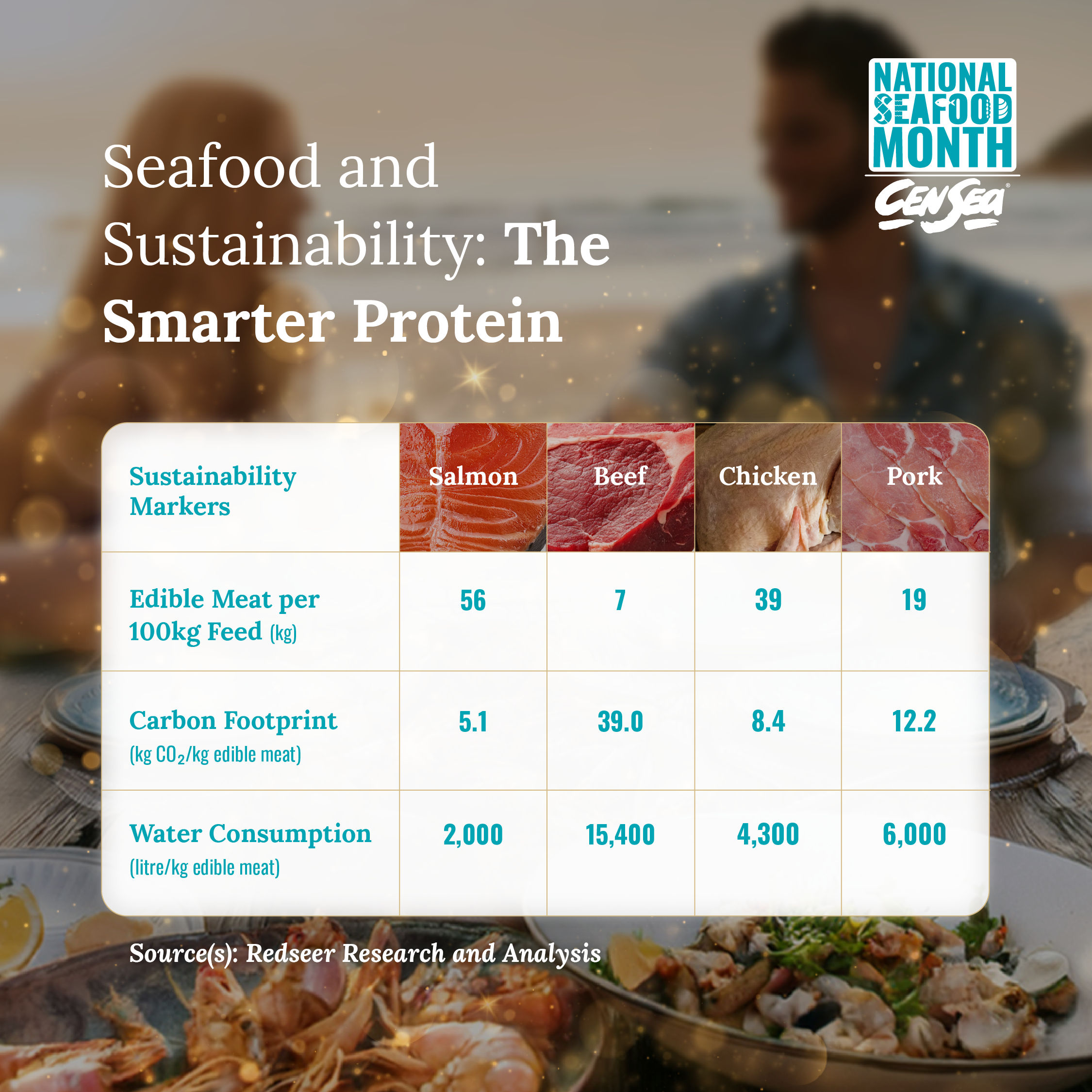
The numbers tell their own story. Salmon delivers significantly more edible protein per unit of feed than beef, pork, or chicken. Its carbon footprint is roughly one-eighth that of beef, and it uses only a fraction of the water.
These are not abstract figures. They show how nations can feed growing populations without exhausting natural resources. For consumers, they serve as a reminder that sustainable seafood is more than a dietary choice; it is a conscious environmental decision.
The U.S. Market Growth Story
The American seafood market is evolving steadily. Once considered mainly a coastal preference, seafood is now finding its place across the country, from supermarkets to online retail platforms.
The seafood industry in the United States is sized at USD 52–58 billion as of Calendar Year 2024 and is projected to reach USD 64–71 billion by Calendar Year 2029, growing at a CAGR of approximately 4.2%. The market remains stable, supported by consistent consumer demand, with effective consumption estimated at around 5.6 million tonnes in 2024 and projected to reach 6.1 million tonnes by 2029, growing at a CAGR of approximately 1.7%.
Seafood currently contributes 6–7% to overall protein consumption, a share expected to rise as consumers look for healthier, sustainable options. Growth is being driven by a wider retail footprint, an expanding e-commerce segment, and the increasing popularity of ready-to-eat (RTE) and ready-to-cook (RTC) seafood products.
Regional differences tell an interesting story. Coastal areas still prefer fresh fish and shellfish, while inland markets are discovering the benefits of frozen and processed seafood, appreciating its convenience, variety, and shelf life.
Retailers and foodservice providers continue to expand their offerings of responsibly sourced, value-added, and innovative seafood-based products. Together, these trends reflect an evolving market where seafood is no longer seasonal or regional, but a growing part of America’s everyday diet.
The Road Ahead: A Future Shaped by Seafood

Change in how we eat is already happening. Across the country, more Americans are discovering that seafood fits naturally into a balanced, thoughtful diet. It’s versatile, nourishing, and closely connected to the idea of eating with care — for ourselves and for the planet
At CenSea, we see that progress every day. In restaurant kitchens, retail shelves, and family meals, seafood is finding a more consistent place at the table. Our role is to support that progress by making sustainable, high-quality seafood accessible and dependable for everyone we serve.
From source to shelf, CenSea is proud to be part of America’s shift toward smarter, more sustainable seafood choices.